
How to Open a Restaurant or Cafe in Chhattisgarh (2026): Licences, Registrations & Launch Checklist
 RestroKhata Team
Quick answer: To open a restaurant or cafe in Chhattisgarh you need an FSSAI registration or licence (compulsory for everyone), a trade/health licence from your Nagar Nigam, and — depending on your size — GST registration, Shops & Establishments registration and a Fire NOC. Start the paperwork about 6–8 weeks before your planned opening date.
Whether you are opening a 20-seat cafe near Telibandha in Raipur, a family restaurant in Bhilai, a dhaba on a highway near Durg or a tea-and-snacks counter in Bilaspur, the list of approvals is largely the same. What changes is your turnover, seating, staff count and building — and those decide which optional registrations apply to you.
This guide is written for first-time owners. It explains each licence in plain language, gives you a realistic timeline, and covers the operational setup (menu pricing, billing, printer, QR menu) that people often leave for the last week.
The Licence Checklist at a Glance
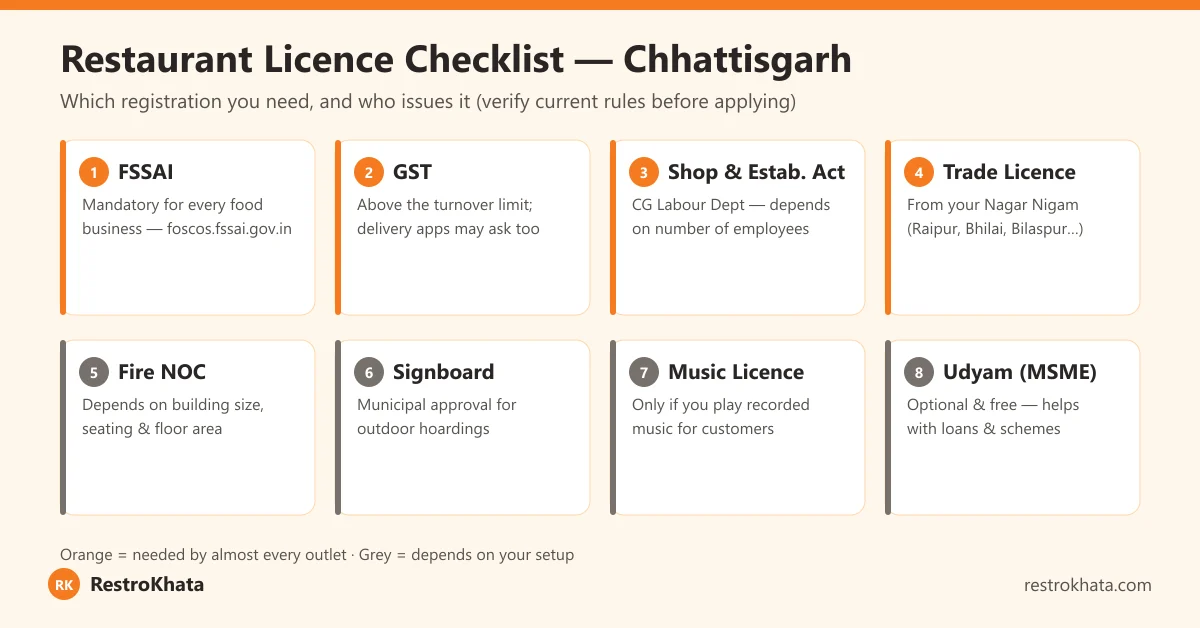
| Licence / Registration | Who needs it | Where to apply |
|---|---|---|
| FSSAI Registration / Licence | Every food business | FoSCoS portal (foscos.fssai.gov.in) |
| GST Registration | Turnover above ₹20 lakh, or voluntary | GST portal (gst.gov.in) |
| Shops & Establishments | Depends on number of employees | Labour Department, Chhattisgarh |
| Trade / Health Licence | Most commercial food outlets | Your Municipal Corporation / Nagar Palika |
| Fire NOC | Depends on building size, height and seating | Fire & Emergency Services |
| Signboard permission | Outdoor hoardings / large signage | Municipal Corporation |
| Music licence | If you play recorded music for customers | Relevant copyright societies / rights owners |
| Udyam (MSME) registration | Optional, free | udyamregistration.gov.in |
Serving alcohol needs a separate excise licence with its own rules and timelines — treat it as a separate project if your concept includes a bar.
1. FSSAI Registration or Licence (Compulsory)
The Food Safety and Standards Authority of India (FSSAI) requires every food business operator to be registered or licensed — including home-based cloud kitchens, tea stalls and food trucks. You apply online on the FoSCoS portal.
- Basic Registration: for small businesses with annual turnover up to ₹12 lakh.
- State Licence: for turnover above ₹12 lakh (up to ₹20 crore) — most full-service restaurants in Raipur, Bhilai and Bilaspur fall here as they grow.
- Central Licence: for very large operations and some specific categories.
Typical documents: photo ID and address proof of the owner, a photograph, proof of possession of the premises (rent agreement or ownership papers), and the list of food categories you will serve. State licences can ask for more, such as a premises layout.
After you get it: display the FSSAI certificate at a visible place in your outlet, and print your FSSAI number on every bill and cash receipt. In RestroKhata you enter the FSSAI number once in settings and it appears on every invoice automatically.
2. GST Registration
Running a restaurant is a supply of services under GST. Registration becomes mandatory when your aggregate turnover crosses ₹20 lakh in a financial year. Many owners register earlier because suppliers, delivery platforms or landlords ask for a GSTIN.
Before you register, decide two things with your CA:
- Regular scheme or Composition scheme. Small restaurants can opt for composition, which has simpler returns but you cannot charge GST separately on the bill or claim input tax credit.
- Price inclusive or exclusive of GST. This decides how your menu prices and bills look. Pick one and apply it consistently.
We have explained restaurant GST rates, invoice format and compliance in detail in our restaurant GST billing guide.
3. Shops & Establishments Registration
Chhattisgarh regulates working hours, holidays and conditions of employment for shops and commercial establishments through its Shops and Establishments law. Whether you must register depends mainly on the number of workers you employ. Check with the Labour Department (Shram Vibhag) for your outlet's category before hiring your full team.
Even if registration is not required for you, keep simple staff records — names, ID, joining date, salary and working hours. It protects you as much as your employees.
4. Trade Licence / Health Licence from the Municipal Corporation
Your local body — for example the Raipur, Bhilai, Durg, Bilaspur or Rajnandgaon Municipal Corporation, or the Nagar Palika in smaller towns — issues a trade or health licence for commercial food outlets. Inspectors may check cleanliness, drainage, waste disposal and kitchen ventilation.
Local tip: In Bhilai, if your shop is inside a BSP township sector, also check the lease and usage conditions with the Bhilai Steel Plant town services, since the premises rules there are different from areas under the municipal corporation.
5. Fire NOC and Fire Safety
Whether you need a formal Fire NOC depends on your building's height, floor area and seating capacity. Restaurants in malls, multi-storey buildings and large banquet-style outlets almost always need one.
Even when a formal NOC is not required, every kitchen should have:
- Fire extinguishers suitable for kitchen fires, within easy reach and in date
- LPG cylinders stored safely with a proper regulator and pipeline
- A clear exit path for customers and staff
- Staff who know how to shut off gas and use an extinguisher
6. Other Registrations You May Need
Signboard permission
Large outdoor signs and hoardings generally need municipal approval and may attract an advertisement fee. Ask before you order a big illuminated board.
Music licence
If you play recorded music for customers — through speakers, a TV or a playlist — you may need licences from the bodies that represent the music rights. Using music from a personal streaming account does not cover commercial use.
Udyam (MSME) registration
Free and fully online. It is not required to operate, but it can help with business loans, government schemes and opening a current account.
A Realistic 8-Week Launch Timeline
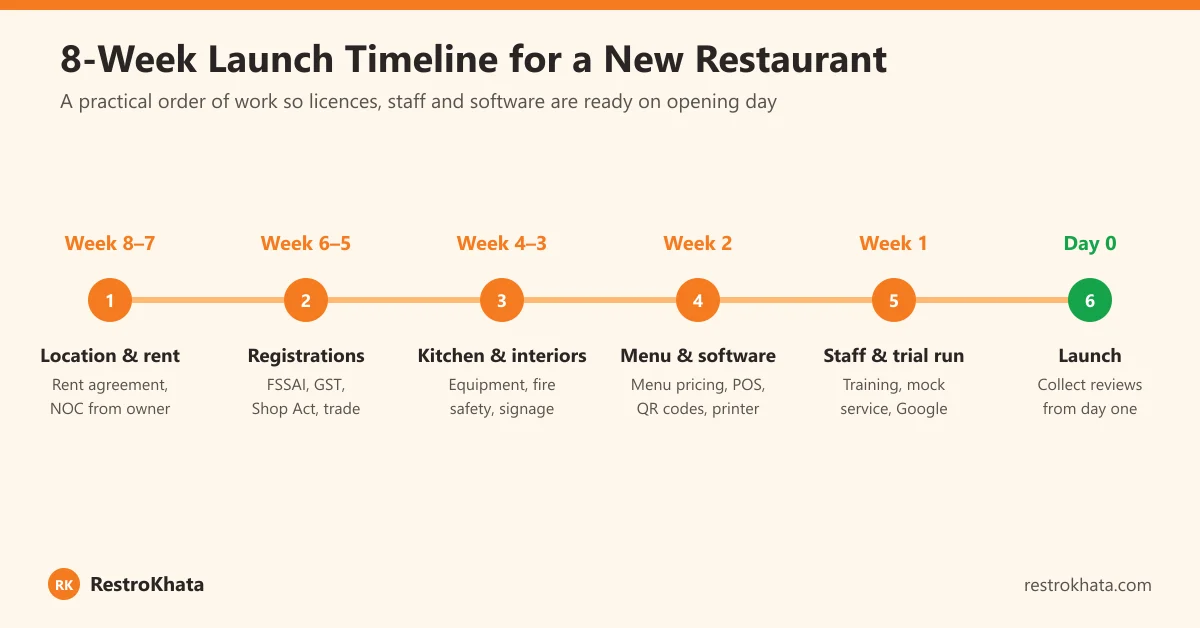
| When | What to finish |
|---|---|
| Week 8–7 | Finalise location, sign rent agreement, get NOC from the property owner for running a food business |
| Week 6–5 | Apply for FSSAI, GST (if needed), Shops & Establishments and trade licence; open a current account |
| Week 4–3 | Kitchen equipment, exhaust, fire safety, interiors and signage; Fire NOC process if applicable |
| Week 2 | Final menu and pricing, billing software setup, thermal printer, table QR codes, UPI account |
| Week 1 | Hire and train staff, run 2–3 mock services with friends and family, create your Google Business Profile |
| Launch day | Open, collect feedback, and start asking every happy guest for a Google review |
Don't Forget the Operations Setup
Licences let you open. Operations decide whether you make money. These are the items new owners most often rush in the final week:
- Menu pricing based on real food cost. Price each dish from its recipe cost, not from what the restaurant next door charges. Our food cost calculation guide shows the exact method with a worked example.
- Billing with GST and FSSAI details. Your invoice should carry your business name, GSTIN (if registered), FSSAI number, tax breakdown and a UPI QR. RestroKhata sets this up in a few minutes from the settings screen.
- Kitchen order flow. Decide whether orders reach the kitchen as printed KOTs, on a kitchen display, or both. See our thermal printer setup guide if you are buying a printer.
- QR menu on tables. Customers scan, browse and order from their phone. Read how a QR menu system works.
- Staff roles from day one. Give waiters, kitchen staff and managers separate logins so that only you can see reports and change settings. This is the simplest way to prevent billing leakage later.
- Google Business Profile. Most new customers will find you on Google Maps. Follow our Google Business Profile guide before launch day.
Common Mistakes First-Time Owners Make
- Rent agreement in a different name from the FSSAI/GST applicant, causing document mismatch and rejections.
- Choosing the wrong FSSAI category (registration vs state licence) and having to re-apply when turnover grows.
- Charging GST on bills without a GSTIN, or charging the wrong rate.
- Handwritten bills in the first month "until things settle" — this is exactly when cash goes unrecorded and habits form.
- No mock service. One trial evening with 15–20 guests shows you every bottleneck between the waiter, the kitchen and the billing counter.
Conclusion
Opening a restaurant in Chhattisgarh is very doable when you sequence the work: secure the premises, apply for FSSAI and your municipal licence early, add GST, Shops & Establishments and Fire NOC as they apply to you, and use the last two weeks for menu pricing, billing setup and staff training. Get the paperwork right once, keep copies of every certificate, and set calendar reminders for renewals.
Frequently Asked Questions
Which licence is compulsory to open a restaurant or cafe in Chhattisgarh?
FSSAI registration or licence is compulsory for every food business, however small. Most outlets also need a trade or health licence from their municipal corporation. GST registration, Shops and Establishments registration and a Fire NOC depend on your turnover, number of employees and building.
What is the difference between FSSAI Basic Registration and State Licence?
FSSAI Basic Registration is for small food businesses with annual turnover up to ₹12 lakh. Businesses above ₹12 lakh (up to ₹20 crore) need an FSSAI State Licence. Both are applied for online on the FoSCoS portal (foscos.fssai.gov.in).
Do I need GST registration for a small cafe?
Restaurant service is treated as a supply of services, so GST registration becomes mandatory once your aggregate turnover crosses ₹20 lakh in a financial year. You can register voluntarily before that. Delivery platforms may also ask for GST details during onboarding, so confirm their current requirements and speak to a CA.
Do I need to print my FSSAI number on restaurant bills?
Yes. FSSAI requires food businesses to mention their FSSAI licence or registration number on cash receipts and invoices. A billing software that prints the FSSAI number automatically on every bill saves you from missing it.
How long does it take to get all licences for a new restaurant?
Plan for roughly 4 to 8 weeks before opening. Online registrations like FSSAI Basic Registration, GST and Udyam can be quick, but trade licences, Fire NOC and inspections take longer. Start registrations as soon as your rent agreement is signed.
Can I start billing customers before my licences arrive?
It is safest to start only after your FSSAI registration is in place, since FSSAI registration is mandatory before operating a food business. If GST registration is pending, do not charge GST on bills until you have a valid GSTIN.
Getting your billing ready before opening day?
Set up your menu, GST and FSSAI details on the invoice, table QR codes and staff roles in RestroKhata before your launch — no special hardware needed.
Start Free Trial →