
Restaurant Food Cost Calculation: Formula, Plate Costing & Menu Pricing (with ₹ Examples)
 RestroKhata Team
Quick answer: Food cost % = (Opening stock + Purchases − Closing stock) ÷ Food sales × 100. To price a dish, work out its plate cost from the recipe, then divide by your target food cost (for example ₹110 ÷ 0.32 ≈ ₹344, rounded to ₹349).
Most restaurant owners know their daily sales. Far fewer know how much of every ₹100 in sales goes back into ingredients. That one number — your food cost percentage — decides whether a busy restaurant actually makes money. Rising vegetable, dairy and edible oil prices make it even more important to check it regularly.
This guide shows two practical methods: the monthly method (how much you really spent) and the plate cost method (how much each dish should cost). Use both — the gap between them shows you where money is leaking.
What Is Food Cost Percentage?
Food cost percentage is the share of your food sales that is spent on the ingredients used to make that food. If you sold ₹1,00,000 worth of food this week and used ₹32,000 of ingredients, your food cost is 32%.
The remaining 68% must pay for rent, salaries, gas and electricity, packaging, marketing, software, repairs — and your profit. That is why even a 3–4 point rise in food cost can wipe out the month's profit for a small cafe.
What is a good number? Many restaurants aim for roughly 28–35% overall. Cafes with a large share of tea, coffee and shakes can run lower; non-veg and paneer-heavy menus usually run higher. Your own trend over time matters more than any industry benchmark.
Method 1: Monthly (Actual) Food Cost
This tells you what you really spent. Do it on the same date every month.
Food cost % = (Opening stock + Purchases − Closing stock) ÷ Food sales × 100
- Opening stock: value of ingredients in your kitchen and store at the start of the month (equal to last month's closing stock).
- Purchases: all food ingredient purchases during the month — vegetables, dairy, grocery, meat, oil. Do not include gas, packaging or cleaning supplies here.
- Closing stock: count and value what is left on the last day.
- Food sales: your total food sales for the month, excluding GST.
| Item (example month) | Amount |
|---|---|
| Opening stock | ₹40,000 |
| + Purchases during the month | ₹1,80,000 |
| − Closing stock | ₹35,000 |
| = Cost of food used | ₹1,85,000 |
| Food sales (excluding GST) | ₹5,60,000 |
| Food cost % | ₹1,85,000 ÷ ₹5,60,000 = 33.0% |
Tip: the hardest part is having all purchases in one place. If you log every vendor payment as an expense with a category (Vegetables, Dairy, Grocery, Meat), the purchase total is ready at month-end. In RestroKhata, expenses are logged by category and your sales and tax totals come from the same dashboard.
Method 2: Plate Cost (Recipe Costing)
Plate cost is what one portion of a dish should cost if it is made exactly to recipe. You need it to set prices and to know which dishes really earn money.
How to calculate plate cost
- Write a standard recipe for one portion, with weights (grams/ml), not "one katori".
- Find the current purchase price per kg or litre of each ingredient.
- Cost of each ingredient = quantity used × price per unit.
- Add a small buffer for wastage and trimming (often around 5%).
- Add up everything — that is your plate cost.
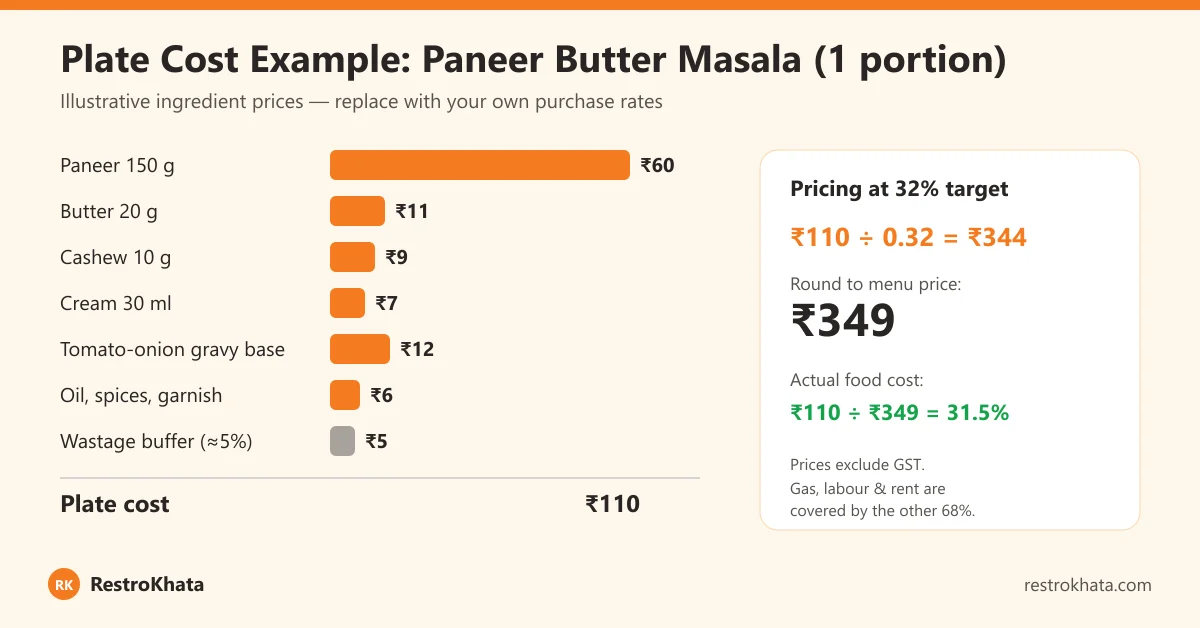
| Ingredient (1 portion) | Quantity | Price used | Cost |
|---|---|---|---|
| Paneer | 150 g | ₹400/kg | ₹60 |
| Butter | 20 g | ₹550/kg | ₹11 |
| Cashew | 10 g | ₹900/kg | ₹9 |
| Fresh cream | 30 ml | ₹220/litre | ₹7 |
| Tomato-onion gravy base | 1 portion | batch cost | ₹12 |
| Oil, spices, garnish | — | estimate | ₹6 |
| Wastage buffer (~5%) | — | — | ₹5 |
| Plate cost | ₹110 | ||
Gravy bases and batch items: for anything you cook in bulk (gravy, dal, rice, chutney), cost the whole batch, then divide by the number of portions it yields.
From Plate Cost to Menu Price
Selling price = Plate cost ÷ Target food cost %
With a plate cost of ₹110 and a target of 32%: ₹110 ÷ 0.32 = ₹344. Round it to a menu-friendly ₹349. Your actual food cost for that dish is then ₹110 ÷ ₹349 = 31.5%.
Then sanity-check the price:
- Local market: what do similar restaurants in your area charge? A dish priced far above the neighbourhood may need a bigger portion or better presentation to justify it.
- Portion perception: if the price feels high, adjust the portion or garnish before you cut the margin.
- GST display: decide whether menu prices are inclusive or exclusive of GST and show it clearly on the menu.
Not every dish needs the same percentage. Tea, coffee, soft drinks, breads and rice often have low food cost and help balance high-cost dishes like paneer, mutton and fish. What matters is your overall percentage.
Dine-in vs Delivery: Same Dish, Different Margin
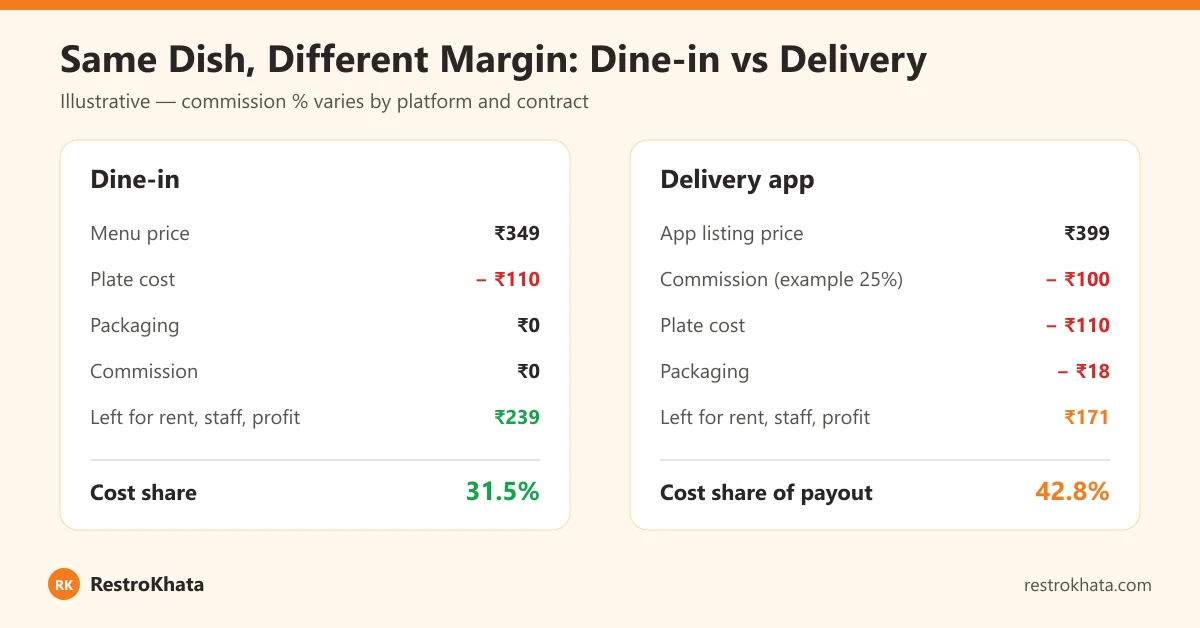
On delivery apps, your payout is reduced by commission and you also pay for packaging. In the example above, the same dish leaves ₹239 for dine-in but only ₹171 on delivery, even at a higher listed price. For delivery menus:
- Count packaging (container, bag, cutlery, sauces) as part of the plate cost.
- Calculate food + packaging cost as a share of the payout, not the listed price.
- Push dishes that travel well and have healthy margins; avoid heavy discounting on high-cost items.
Running a delivery-only kitchen? See our cloud kitchen guide.
Menu Engineering: Which Dishes to Push, Fix or Remove
Once you know each dish's margin (selling price minus plate cost) and how many plates you sell, sort your menu into four groups:
| Group | Sells a lot? | High margin? | What to do |
|---|---|---|---|
| Stars | Yes | Yes | Keep quality consistent, feature on top of menu |
| Workhorses | Yes | No | Re-cost the recipe, adjust portion or raise price slightly |
| Puzzles | No | Yes | Better description, photo, staff recommendation |
| Dogs | No | No | Remove or replace — they also add wastage |
With a digital QR menu you can update a dish's price, description or availability instantly instead of reprinting menus — useful when you are testing these changes.
Why Your Actual Food Cost Is Higher Than Your Recipe Cost
If your monthly food cost is 36% but recipe costing says it should be 31%, the 5-point gap is money leaving the kitchen. The usual causes:
- Over-portioning: no standard ladles, scoops or weighing for paneer and meat.
- Wastage and spoilage: over-ordering perishables, poor storage, no first-in-first-out.
- Staff meals: fine to give, but they should be counted.
- Supplier price creep: small increases nobody notices until the month-end.
- Food made but not billed: a KOT went to the kitchen but no bill was generated. Read how to stop billing leakage.
- Order mistakes: wrong dishes that are remade. See how to reduce order mistakes.
A Simple Monthly Routine
- Log every ingredient purchase as an expense, by category, on the day you pay.
- Count closing stock on the last day of the month (takes 30–45 minutes with a printed list).
- Calculate monthly food cost % using the formula above.
- Re-cost your top 10 dishes whenever a key ingredient price moves noticeably.
- Review prices and menu groups every quarter.
Conclusion
Food cost is not an accounting exercise — it is the clearest signal of how well your kitchen is run. Calculate plate cost for every dish, price from that number, and check your actual monthly food cost against it. The restaurants that do this every month are the ones that stay profitable when vegetable and dairy prices jump.
Frequently Asked Questions
What is the formula for food cost percentage?
Food cost % = (Opening stock + Purchases − Closing stock) ÷ Food sales × 100. For a single dish, food cost % = Plate cost ÷ Selling price × 100. Use sales excluding GST.
What is a good food cost percentage for a restaurant in India?
Many restaurants aim for roughly 28–35% overall, but the right number depends on your format. Tea, coffee and beverages usually run lower, while paneer, mutton and seafood dishes run higher. Track your own number every month and work on bringing it down steadily rather than chasing a single benchmark.
How do I calculate the selling price of a dish from its cost?
Divide the plate cost by your target food cost percentage. For example, a dish that costs ₹110 to make at a 32% target should be priced at about ₹110 ÷ 0.32 = ₹344, which you can round to ₹349. Then compare with local competitors and adjust.
Should GST be included when calculating food cost?
No. Use sales excluding GST, because GST collected from customers is not your revenue. If your menu prices are GST-inclusive, remove the GST portion from sales before calculating food cost percentage.
Why is my food cost higher than my recipe costing shows?
The gap between theoretical (recipe) food cost and actual food cost usually comes from over-portioning, wastage, spoilage, staff meals, supplier price increases, and food that was prepared but never billed. Comparing KOTs with bills and standardising portions closes most of the gap.
Should I keep the same price on Zomato or Swiggy as my dine-in menu?
Many restaurants list a slightly higher price on delivery apps because commission and packaging reduce the payout. Calculate your food and packaging cost as a share of the payout you actually receive, then decide the app price. Check each platform's current pricing policies before changing prices.
Know your sales and expenses every day
RestroKhata gives you daily sales, tax and payment-mode reports plus category-wise expense logging — the two numbers you need for food cost — on your phone.
Start Free Trial →